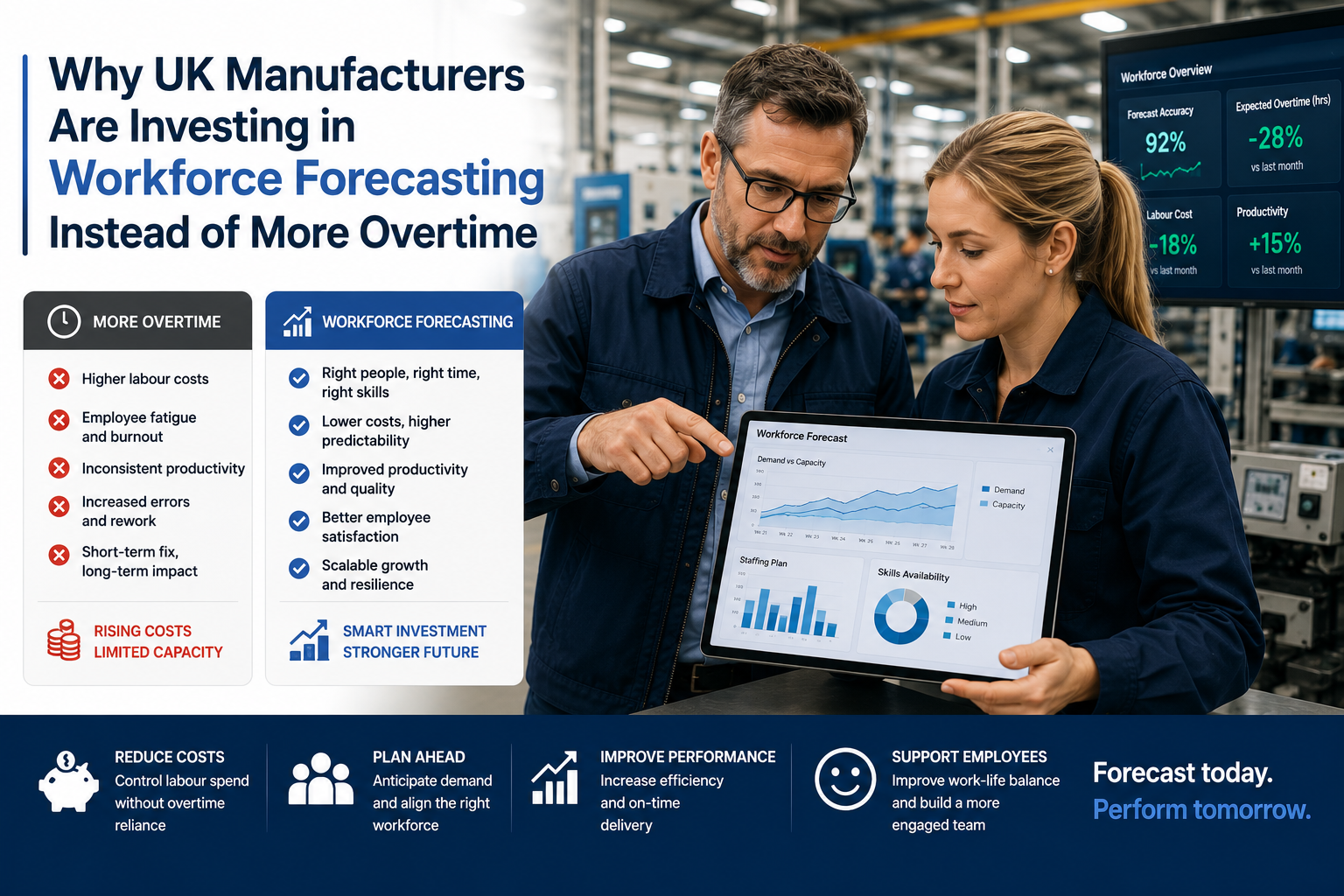
Manufacturing leaders across the UK are facing a challenge that has become increasingly difficult to ignore. Labour costs continue to rise, skilled workers remain difficult to recruit, customer demand fluctuates more frequently, and production schedules have become increasingly complex. In response, many organisations have spent years relying on overtime as the quickest solution to workforce shortages and operational pressure.
When a shift runs short, overtime is approved. When demand increases unexpectedly, additional hours are added. When absenteeism affects production, existing employees are often asked to fill the gap. While this approach can solve immediate problems, many manufacturers are beginning to realise that it does little to address the underlying workforce challenges creating those problems in the first place.
As a result, workforce planning is becoming a boardroom discussion rather than simply an operational responsibility. CEOs are looking for ways to improve productivity without increasing labour costs. CFOs are searching for greater cost predictability and workforce efficiency. COOs are under pressure to maintain operational stability despite ongoing workforce challenges.
This shift in thinking is driving increased investment in Workforce Forecasting Software, Manufacturing Workforce Management Software, and Workforce Planning Software. Rather than relying on overtime to react to workforce issues, manufacturers are increasingly focusing on forecasting labour requirements earlier and making more informed workforce decisions before disruption occurs.
The goal is not to predict the future perfectly. The goal is to create enough workforce visibility to make better operational decisions and reduce unnecessary labour costs.
What’s Inside
Why Is Workforce Planning Becoming More Challicated for Manufacturers?
Manufacturing has always required careful planning, but workforce planning has become significantly more challenging over the last decade. Labour shortages continue to affect many sectors, experienced employees are becoming harder to recruit, and production schedules often need to adapt quickly to changing customer demand.
In the past, organisations could often rely on relatively stable workforce patterns. Staffing requirements were more predictable, employee retention levels were generally higher, and production schedules changed less frequently. Today’s manufacturing environment is very different. Workforce availability can fluctuate rapidly, operational requirements can change unexpectedly, and labour market conditions continue to create uncertainty.
These challenges have exposed weaknesses in traditional workforce planning approaches. Many manufacturers still rely on spreadsheets, manual scheduling processes, and historical reports to make workforce decisions. While these methods may provide some visibility, they often fail to identify workforce risks early enough to prevent disruption.
The result is that managers frequently find themselves responding to workforce challenges after they occur rather than before. A staffing shortage may only become visible when a shift is already affected. Labour demand may increase before additional resources have been allocated. Absenteeism trends may go unnoticed until overtime costs begin to rise.
This reactive approach creates operational pressure throughout the organisation. Production teams struggle to maintain efficiency, supervisors spend time firefighting workforce issues, and labour costs become increasingly difficult to control.
This is one reason manufacturers are investing in Workforce Planning Software. By improving workforce visibility and forecasting labour requirements more accurately, organisations can move from reactive workforce management towards proactive workforce planning.
Why Is Overtime No Longer a Long-Term Workforce Strategy?
For many years, overtime was viewed as one of the most effective ways to manage fluctuations in manufacturing demand. When production volumes increased unexpectedly or workforce shortages emerged, additional hours provided a practical solution that allowed operations to continue without significant disruption.
In moderation, overtime remains an important workforce management tool. Most manufacturers will always require some level of overtime to respond to unexpected events or temporary increases in demand. The problem arises when overtime becomes the primary solution to workforce challenges rather than a strategic operational tool.
Many organisations now find themselves relying on overtime week after week simply to maintain normal production levels. What was originally intended to provide flexibility gradually becomes embedded within everyday workforce planning. As a result, labour costs continue to increase while workforce stability becomes harder to maintain.
One of the reasons this happens is because overtime often masks deeper workforce management issues. Attendance challenges, scheduling inefficiencies, labour shortages, and poor workforce visibility can all contribute to increased overtime requirements. While additional hours may help organisations achieve short-term production targets, they rarely address the underlying causes of workforce disruption.
There is also a human cost associated with excessive overtime. Employees who consistently work extended hours may experience increased fatigue, reduced engagement, and greater levels of stress. Over time, this can contribute to absenteeism, lower productivity, and increased employee turnover. Ironically, the overtime being used to solve workforce shortages can end up creating additional workforce instability.
This is why many manufacturers are beginning to shift their focus towards Manufacturing Workforce Management Software and Workforce Forecasting Software. Rather than relying on overtime as the first response to workforce challenges, they are investing in solutions that help identify risks earlier and improve workforce planning.
How Does Workforce Forecasting Improve Operational Decision-Making?
One of the biggest advantages of Workforce Forecasting Software is that it enables organisations to make decisions before problems begin affecting operations. Instead of reacting to workforce challenges after they occur, manufacturers gain visibility into future workforce requirements and can take action earlier.
Forecasting allows organisations to analyse labour demand, workforce availability, attendance trends, and operational requirements together. This creates a clearer understanding of what workforce resources will be needed in the weeks and months ahead.
For example, if production demand is expected to increase significantly during a particular period, managers can begin preparing workforce plans in advance. Additional shifts can be scheduled, recruitment requirements can be identified, and labour allocation can be adjusted before operational pressure begins to build.
Similarly, workforce forecasting can help organisations identify potential labour shortages before they affect production schedules. Rather than discovering staffing issues at the last minute, managers gain the opportunity to respond proactively.
This level of visibility improves decision-making throughout the organisation. Supervisors spend less time reacting to workforce challenges. Operations teams gain greater confidence in workforce planning. Leadership teams are able to make strategic decisions based on data rather than assumptions.
In an environment where workforce stability is becoming increasingly difficult to maintain, this proactive approach can provide a significant competitive advantage.
Why Are Manufacturers Combining Workforce Forecasting With Time and Attendance Software?
Accurate forecasting depends on accurate workforce data. Without reliable information regarding workforce availability, attendance trends, and labour utilisation, forecasting becomes far less effective.
This is why many manufacturers are integrating Time and Attendance Software for Manufacturing with workforce forecasting processes.
Attendance data provides valuable insight into workforce behaviour. Organisations can monitor attendance patterns, identify recurring absence trends, and assess workforce availability with greater accuracy. This information allows forecasting models to reflect real workforce conditions rather than assumptions.
For example, if attendance trends indicate that certain departments experience higher absence rates during specific periods, workforce plans can be adjusted accordingly. Similarly, organisations can identify seasonal workforce challenges and prepare for them in advance.
Many manufacturers are also implementing Attendance Management Software to improve workforce visibility and strengthen forecasting accuracy. By combining attendance data with production forecasts and workforce planning activities, organisations gain a more complete understanding of future labour requirements.
The result is better planning, stronger workforce allocation, and reduced operational disruption.
How Can Workforce Forecasting Help Control Labour Costs?
Labour costs remain one of the largest operational expenses for most manufacturing businesses. While organisations often focus on wage increases, many labour cost challenges are actually created by workforce inefficiencies.
Last-minute overtime, reactive scheduling, temporary labour requirements, and poor workforce allocation can all contribute to higher labour expenditure. These costs often develop gradually and may not become visible until significant operational disruption has already occurred.
By implementing Manufacturing Workforce Analytics and Workforce Forecasting Software, organisations gain greater visibility into the factors driving labour costs. Managers can analyse workforce trends, identify inefficiencies, and make adjustments before costs escalate.
Forecasting also improves resource allocation. Rather than overstaffing to avoid risk or understaffing and relying on overtime, organisations can align workforce resources more accurately with operational demand. This creates greater efficiency while maintaining productivity levels.
For CFOs, this improved visibility supports stronger financial planning and cost control. Labour expenditure becomes more predictable, workforce decisions become more informed, and operational efficiency improves.
As economic pressures continue to affect the manufacturing sector, this level of workforce visibility is becoming increasingly valuable.
Why Is Workforce Forecasting Becoming a Strategic Priority for Manufacturing Leaders?
The workforce challenges facing manufacturers are unlikely to disappear in the near future. Skills shortages continue to affect many industries, labour costs remain under pressure, and operational complexity continues to increase.
At the same time, leadership teams are expected to improve productivity, maintain profitability, and strengthen workforce stability.
This combination of pressures is driving increased interest in workforce forecasting. Organisations recognise that reactive workforce management is becoming increasingly difficult to sustain. Waiting until workforce issues affect production is no longer an effective strategy.
By investing in Manufacturing Workforce Management Software, Workforce Planning Software, and Time and Attendance Software for Manufacturing, organisations gain greater visibility into workforce activity and future labour requirements.
This enables leaders to make workforce decisions based on evidence rather than assumptions. Planning becomes more accurate, labour allocation becomes more efficient, and workforce stability improves.
Most importantly, organisations become better equipped to manage future workforce challenges.
Conclusion
For many years, overtime served as the default solution to workforce challenges within manufacturing. While it remains an important operational tool, it is becoming increasingly clear that overtime alone cannot solve the workforce pressures facing modern manufacturers.
Organisations that continue to rely heavily on reactive workforce management often experience rising labour costs, workforce instability, increased absenteeism, and ongoing operational disruption. By contrast, manufacturers investing in Workforce Forecasting Software, Workforce Planning Software, Manufacturing Workforce Management Software, Time and Attendance Software for Manufacturing, and Manufacturing Workforce Analytics are creating a more proactive approach to workforce management.
The objective is not perfect prediction. It is better visibility.
When manufacturers can see workforce risks developing before they affect operations, they can make better decisions, reduce unnecessary overtime, improve workforce allocation, and strengthen operational performance. In an increasingly competitive manufacturing environment, workforce forecasting is becoming far more than a planning tool. It is becoming a strategic advantage.