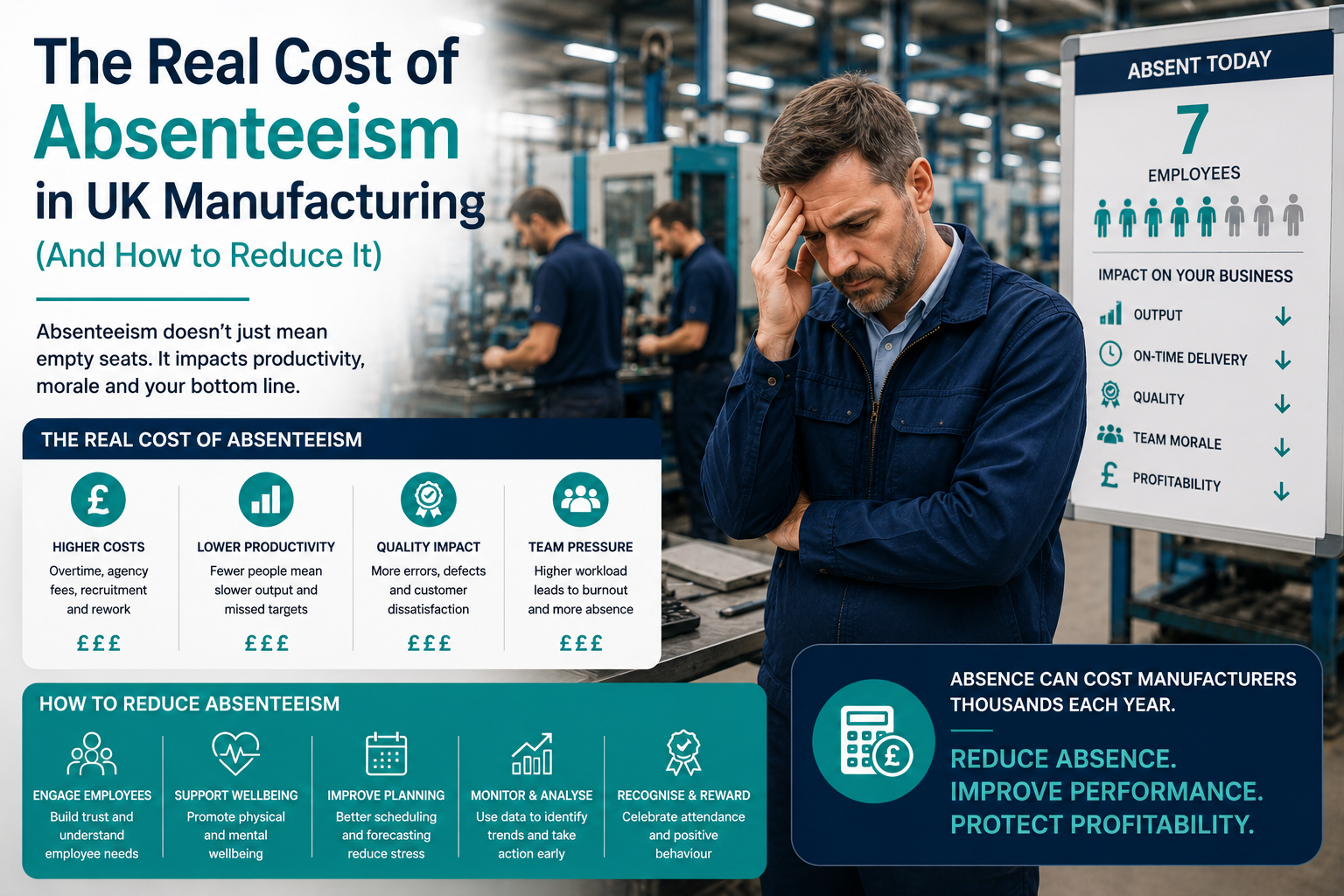
Absenteeism has become one of the most significant workforce challenges facing UK manufacturers today. While a single absence may appear relatively minor on the surface, the operational impact often extends far beyond one employee being unavailable for work.
Manufacturing environments depend on consistency. Production schedules are carefully planned, labour resources are allocated based on expected demand, and operational efficiency relies on having the right people in the right place at the right time. When unexpected absences occur, that balance can quickly be disrupted.
For many manufacturers, absenteeism creates a chain reaction across the organisation. Overtime increases, supervisors spend time adjusting schedules, workforce pressure grows, and production targets become harder to achieve. While these issues are often viewed as isolated operational challenges, they frequently stem from the same root cause.
The reality is that absenteeism is no longer simply an HR issue. It has become an operational and financial challenge that directly affects productivity, labour costs, workforce stability, and profitability.
This is why more manufacturers are investing in Attendance Management Software, Time and Attendance Software for Manufacturing, and Manufacturing Workforce Management Software. By improving workforce visibility and gaining access to real-time attendance data, organisations can identify workforce risks earlier and make better operational decisions.
The manufacturers that are managing absenteeism most effectively today are not simply tracking attendance. They are using workforce data to strengthen planning, improve workforce accountability, and reduce operational disruption.
What’s Inside
Why Has Absenteeism Become Such a Major Challenge for Manufacturers?
Manufacturing businesses are operating in an environment where workforce availability has become increasingly difficult to predict.
Labour shortages continue to affect many sectors, experienced employees remain difficult to replace, and production schedules are often under constant pressure. As a result, even small changes in workforce availability can have a significant impact on operations.
Unlike some industries where work can be redistributed easily, manufacturing environments often depend on specific skills, shift coverage, and workforce capacity. When an employee is absent unexpectedly, replacing that individual may not be straightforward.
Supervisors are often required to make immediate adjustments to maintain production targets. Additional overtime may be approved, employees may be reassigned to different tasks, or production schedules may need to be modified. While these actions can help minimise disruption, they often create additional pressure elsewhere in the operation.
Many organisations also underestimate the cumulative impact of absenteeism. A single absence may not create significant disruption. However, when absenteeism becomes a recurring workforce challenge, the operational and financial consequences can be substantial.
This is one reason why manufacturers are increasingly focusing on Attendance Tracking Software and Real-Time Workforce Management. Improving visibility into attendance patterns allows organisations to identify workforce risks before they begin affecting production.
What Is the True Cost of Absenteeism Beyond Lost Hours?
Many organisations measure absenteeism by calculating the number of working hours lost.
While this provides a useful starting point, it rarely reflects the full cost to the business.
The most visible impact is often overtime expenditure. When a shift becomes short, additional hours are frequently required to maintain production output. Over time, these costs can accumulate significantly, particularly when absenteeism levels remain consistently high.
However, overtime is only one part of the equation.
Absenteeism can also affect productivity. When experienced employees are unavailable, production teams may need to operate with reduced workforce capacity or rely on less experienced staff. This can affect efficiency, quality, and overall output.
There are also indirect costs associated with management time. Supervisors often spend valuable hours adjusting schedules, finding replacement workers, and managing workforce disruption. This time could otherwise be spent focusing on operational improvement and production performance.
Employee morale can be affected as well. When workforce shortages become common, employees may experience increased workloads, additional pressure, and reduced schedule stability. Over time, this can contribute to fatigue, disengagement, and further absenteeism.
This is why many manufacturing leaders are turning to Manufacturing Workforce Analytics. By understanding the true drivers of absenteeism and its operational impact, organisations can make more informed workforce decisions and reduce unnecessary labour costs.
Why Are Traditional Attendance Management Processes No Longer Enough?
Many manufacturers continue to manage attendance through manual processes, spreadsheets, paper records, or disconnected systems.
While these methods may provide basic attendance records, they often fail to deliver the workforce visibility required in modern manufacturing environments.
One of the biggest challenges is timing.
By the time attendance reports are reviewed, the operational impact has often already occurred. Workforce shortages have already affected production, overtime has already been approved, and scheduling adjustments have already been made.
This reactive approach makes it difficult to address attendance issues before they begin affecting operations.
Manual processes can also make it harder to identify workforce trends. Recurring absence patterns, departmental attendance concerns, and emerging workforce risks may remain hidden within large volumes of attendance data.
As manufacturing operations become more complex, this lack of visibility becomes increasingly problematic.
This is why organisations are implementing Attendance Management Software and Time and Attendance Software for Manufacturing. These solutions provide real-time access to workforce data, enabling managers to identify attendance issues earlier and respond more effectively.
The objective is not simply to record attendance. It is to create meaningful workforce visibility that supports better decision-making.
How Can Attendance Management Software Improve Workforce Visibility?
One of the biggest advantages of Attendance Management Software is its ability to transform attendance data into actionable workforce insights.
Instead of relying on historical reports, managers gain access to real-time workforce information. Attendance patterns become easier to monitor, workforce availability becomes more transparent, and staffing risks can be identified much earlier.
This level of visibility enables organisations to move away from reactive workforce management.
For example, if attendance trends indicate that a particular department is experiencing increased absence levels, managers can investigate potential causes before workforce shortages begin affecting production. Similarly, recurring attendance issues can be addressed proactively rather than after operational disruption has already occurred.
Many manufacturers are also integrating attendance data with Manufacturing Workforce Management Software and Workforce Planning Software. This creates a more complete picture of workforce activity and supports stronger workforce planning decisions.
When organisations can clearly see attendance trends, labour availability, and workforce capacity, they are in a much stronger position to manage workforce challenges effectively.
The result is improved workforce stability, reduced overtime dependency, and stronger operational performance.
How Does Better Attendance Management Support Labour Cost Control?
Labour costs remain one of the largest expenses within most manufacturing businesses.
However, many organisations focus on controlling labour costs without fully understanding the workforce factors driving those costs.
Absenteeism is one of those factors.
When workforce shortages occur unexpectedly, organisations often incur additional labour expenditure through overtime, temporary staffing, and schedule adjustments. These costs may appear separately within financial reports, but they are often connected to underlying attendance challenges.
By implementing Time and Attendance Software for Manufacturing and Manufacturing Workforce Analytics, organisations gain greater visibility into workforce behaviour and labour utilisation.
This enables managers to identify attendance trends that contribute to increased labour costs and take action before those costs escalate further.
Improved attendance visibility also supports more accurate workforce planning. Managers can allocate resources more effectively, anticipate workforce shortages, and reduce the need for last-minute staffing decisions.
For CFOs, this creates stronger control over labour expenditure.
For COOs, it improves workforce stability and operational planning.
For CEOs, it provides greater confidence in workforce performance and organisational resilience.
Why Is Attendance Data Becoming a Strategic Asset for Manufacturers?
Historically, attendance management was often viewed as an administrative task.
Today, that perception is changing rapidly.
As workforce challenges continue to affect manufacturing organisations, attendance data is becoming an increasingly valuable source of operational intelligence.
Attendance trends provide insight into workforce stability, employee engagement, labour availability, and operational risk. When analysed effectively, this information can help organisations make better workforce decisions and improve overall business performance.
This is one reason manufacturers are investing in Manufacturing Workforce Management Software, Attendance Management Software, and Workforce Planning Software. These solutions enable organisations to transform workforce data into actionable insights that support both operational and strategic objectives.
The manufacturers gaining the greatest value from attendance data are not simply using it to monitor employee attendance.
They are using it to improve workforce planning, strengthen labour allocation, reduce operational disruption, and build more resilient operations.
Conclusion
Absenteeism is no longer simply an attendance issue.
It is a workforce visibility issue, an operational issue, and increasingly a financial issue.
When absenteeism affects manufacturing operations, the impact often extends far beyond lost hours. Overtime costs increase, workforce pressure grows, production schedules become more difficult to manage, and labour costs rise.
The manufacturers addressing these challenges most effectively are focusing on workforce visibility rather than simply attendance monitoring.
By investing in Attendance Management Software, Time and Attendance Software for Manufacturing, Manufacturing Workforce Management Software, Manufacturing Workforce Analytics, and Workforce Planning Software, organisations can identify attendance risks earlier, improve workforce stability, reduce overtime dependency, and strengthen operational performance.
As workforce challenges continue to evolve across the UK manufacturing sector, attendance management is becoming a critical component of effective workforce management.
The businesses that gain greater visibility into their workforce today will be better positioned to build more productive, efficient, and resilient operations tomorrow.