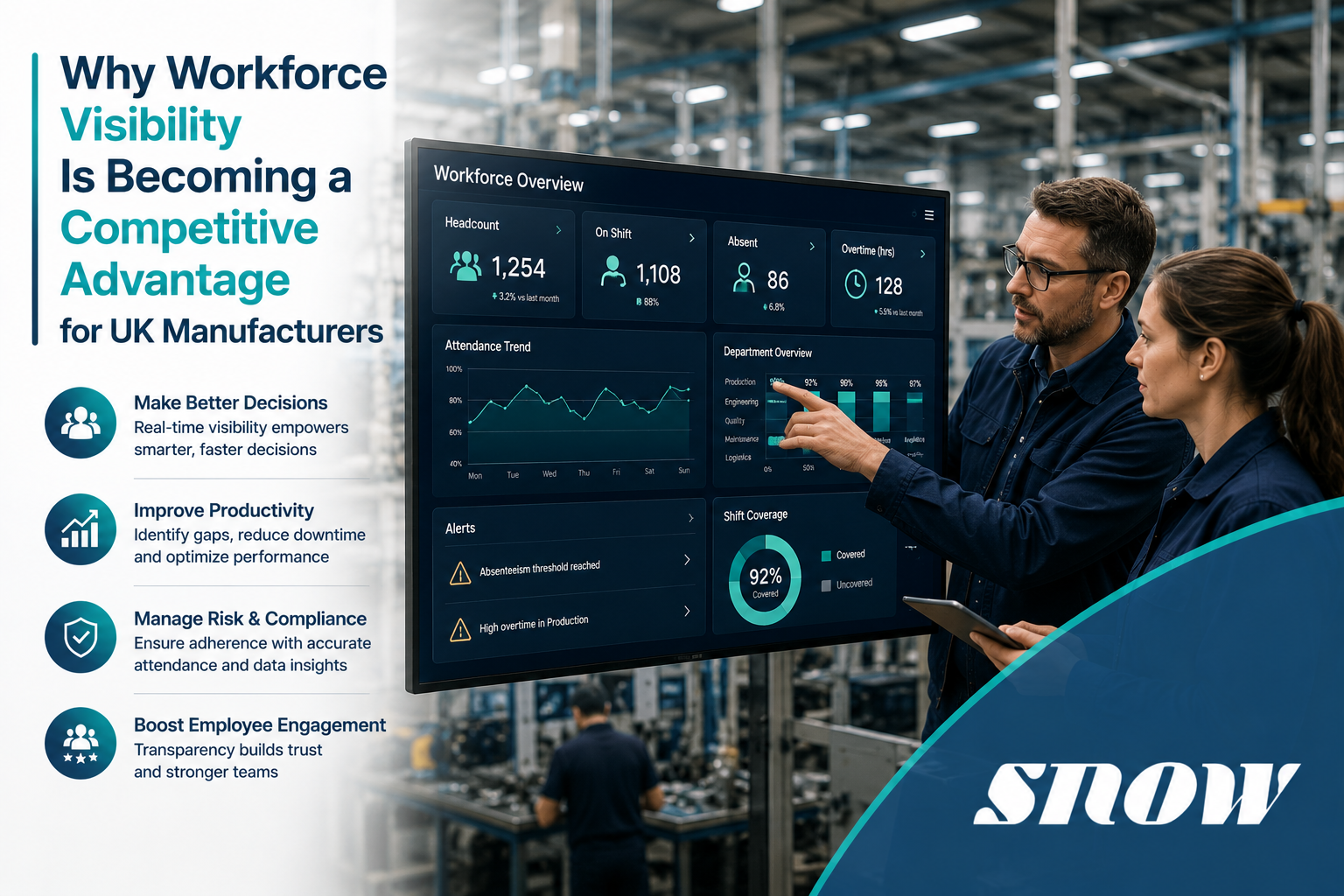
The UK manufacturing sector is facing a unique set of workforce challenges. Rising labour costs, skills shortages, increasing customer expectations, and ongoing pressure to improve productivity are forcing manufacturers to rethink how they manage their workforce.
While many organisations have invested heavily in automation, machinery, and production technology, workforce management often remains a blind spot. Manufacturers can monitor production output in real time, track machine performance instantly, and analyse operational data across multiple facilities. Yet many still struggle to answer simple workforce questions.
Who is available for the next shift?
Where are labour shortages developing?
Which departments are relying heavily on overtime?
What attendance trends are emerging?
These questions have become increasingly important because workforce challenges are no longer isolated HR issues. They directly affect operational performance, labour costs, productivity, and profitability.
This is why Manufacturing Workforce Management Software is becoming a strategic investment for forward-thinking manufacturers. Organisations that gain greater workforce visibility are finding it easier to control labour costs, improve workforce planning, and make faster operational decisions.
What’s Inside
Why Are Manufacturers Struggling to Gain Workforce Visibility?
Many manufacturers still manage workforce operations using multiple disconnected systems. Attendance records may sit in one platform, scheduling information in another, leave requests in emails, and workforce reports in spreadsheets.
While these processes may appear manageable on a day-to-day basis, they often create significant visibility gaps.
Managers spend valuable time gathering workforce information rather than using it. By the time workforce issues become visible, the operational impact has often already begun.
A shift may be understaffed.
An absence may affect production.
Overtime may already have been approved.
A labour shortage may be creating bottlenecks on the shop floor.
The challenge is not a lack of workforce data. Most organisations already have access to large amounts of workforce information.
The challenge is transforming that information into meaningful operational visibility.
This is where Real-Time Workforce Management is becoming increasingly valuable. Rather than relying on historical reports, manufacturing leaders can access workforce information as it happens, allowing them to identify potential issues before they affect production.
How Does Poor Workforce Visibility Impact Manufacturing Operations?
Many manufacturing leaders underestimate the operational cost of limited workforce visibility.
When managers cannot see workforce risks developing, decision-making becomes reactive. Instead of planning ahead, supervisors find themselves responding to problems as they occur.
One of the most common consequences is increased overtime.
Without visibility into attendance trends and workforce availability, labour shortages are often identified too late. Managers then have little choice but to approve additional overtime to maintain production targets.
Scheduling challenges also become more difficult to manage. Last-minute absences, shift changes, and fluctuating production demands create operational pressure when workforce information is not easily accessible.
The impact extends beyond labour costs.
Poor workforce visibility can affect production schedules, workforce morale, employee retention, and customer service levels. Small workforce disruptions can quickly escalate into larger operational challenges when organisations lack the information needed to respond proactively.
Manufacturers that invest in Employee Scheduling Software for Manufacturing often find they can identify staffing issues earlier and make more informed scheduling decisions. This creates greater workforce stability and reduces operational disruption.
Why Is Workforce Visibility Becoming a Boardroom Discussion?
Historically, workforce management was often viewed as an operational or HR responsibility.
Today, that perspective is changing.
For CEOs, workforce visibility is increasingly linked to productivity and organisational performance.
For CFOs, workforce visibility influences labour costs, overtime expenditure, and workforce efficiency.
For COOs, workforce visibility directly impacts production planning and operational stability.
As labour costs continue to rise across the UK manufacturing sector, workforce decisions are becoming more financially significant.
Organisations that lack workforce visibility often struggle to understand where labour costs are being generated and how workforce resources are being utilised.
This creates uncertainty.
By contrast, organisations using Workforce Analytics Software can gain a much clearer understanding of workforce performance. They can identify trends, monitor labour utilisation, and make data-driven decisions that improve operational outcomes.
Workforce visibility is no longer simply about tracking attendance.
It is about creating a more intelligent and agile workforce operation.
How Can Real-Time Attendance Data Improve Workforce Planning?
One of the biggest barriers to effective workforce planning is delayed information.
Traditional attendance processes often provide visibility after workforce issues have already occurred. Managers may only discover attendance concerns when shifts are short or production schedules are affected.
This reactive approach creates unnecessary operational pressure.
With Attendance Management Software for Manufacturing, organisations can access workforce information in real time. Attendance data becomes immediately available, allowing managers to identify issues earlier and respond more effectively.
This level of visibility supports better workforce planning.
Managers can monitor attendance patterns, identify recurring absence trends, and assess workforce availability more accurately.
Over time, this helps organisations build more stable workforce operations.
The benefits extend beyond attendance management alone.
Improved workforce visibility also supports stronger scheduling decisions, better labour allocation, and more effective resource planning.
As workforce challenges continue to evolve, manufacturers increasingly recognise that workforce planning begins with accurate workforce data.
Why Are Manufacturers Investing in Workforce Planning Software?
Manufacturing environments are becoming more dynamic than ever before.
Labour shortages, changing customer demands, supply chain pressures, and economic uncertainty require organisations to make workforce decisions quickly.
Reactive workforce management is becoming increasingly difficult to sustain.
As a result, many manufacturers are investing in Workforce Planning Software to improve forecasting and decision-making.
Workforce planning software enables organisations to anticipate workforce requirements rather than simply reacting to them.
Managers can assess labour demand, evaluate workforce availability, and identify potential staffing risks before they affect operations.
This creates significant advantages.
Production planning becomes more accurate.
Labour allocation improves.
Overtime dependence decreases.
Workforce stability increases.
Perhaps most importantly, managers gain more time to focus on operational improvement rather than constant workforce firefighting.
How Does Workforce Visibility Support Labour Cost Control?
Labour costs represent one of the largest operational expenses for most manufacturing organisations.
However, controlling labour costs is not simply about reducing headcount or cutting hours.
Effective labour cost control requires visibility.
Manufacturers need to understand where labour costs are being generated and what factors are influencing workforce expenditure.
Without this visibility, organisations often rely on assumptions rather than evidence.
For example, many businesses focus heavily on overtime costs while overlooking the underlying workforce challenges that create overtime in the first place.
Using Manufacturing Time and Attendance Software, organisations can gain a clearer understanding of attendance patterns, labour utilisation, overtime trends, and workforce performance.
This enables more informed workforce decisions.
Rather than reacting to labour cost increases after they occur, organisations can identify opportunities for improvement before costs escalate.
Over time, this creates stronger financial control and more efficient workforce operations.
Why Will Workforce Visibility Become Even More Important in the Future?
The manufacturing sector is unlikely to become less complex in the coming years.
Labour shortages continue to affect many organisations. Workforce expectations are changing. Operational demands are increasing.
At the same time, business leaders are under pressure to improve efficiency while maintaining productivity.
In this environment, workforce visibility will become increasingly valuable.
Manufacturers that invest in Manufacturing Workforce Management Software, Attendance Management Software, and Workforce Planning Software will be better positioned to manage workforce challenges effectively.
They will have greater visibility into workforce activity, stronger forecasting capabilities, and more control over labour costs.
Most importantly, they will be able to make workforce decisions proactively rather than reactively.
That capability is becoming a significant competitive advantage.
Conclusion
The manufacturers achieving the strongest operational performance today are not necessarily the ones with the largest workforce or the biggest production facilities.
They are often the organisations with the clearest visibility into their workforce.
By investing in Manufacturing Workforce Management Software, Employee Scheduling Software for Manufacturing, Attendance Management Software, Workforce Planning Software, and Workforce Analytics, manufacturers can improve decision-making, reduce operational disruption, and strengthen workforce stability.
As workforce challenges continue to evolve across the UK manufacturing sector, visibility is becoming more than an operational benefit. It is becoming a competitive advantage.